
AI Therapy: What It Is, How It Works, and Whether It Actually Helps
AI therapy is a supportive, therapy-style conversation with an AI that listens, helps you make sense of what you’re feeling, and walks you through evidence-based coping techniques — any time, day or night. Nearly half of people who could benefit from therapy can’t easily reach it, according to Stanford HAI research, which is part of why these chat-based tools have grown so quickly. You can try AI therapy right on this page, for free, with no sign-up.
It is not a licensed clinician and not a crisis service — but used well, it’s a private, always-available first step for stress, anxiety, low mood, and simply thinking things through.

What is AI therapy?
An AI therapist, AI therapy chatbot, or AI wellness companion uses large language models to hold a supportive, therapy-style conversation, and it’s worth understanding what that means before you rely on one.
A plain-language definition
AI therapy uses a large language model (LLM) — the same underlying technology behind general-purpose AI chatbots — trained and prompted to hold a supportive, therapy-style conversation. An AI therapy chatbot reflects back what you say, asks gentle follow-up questions, and suggests coping strategies grounded in real therapeutic methods rather than generic advice. Accessibility is the core pitch: roughly half of people who could benefit from therapy can’t easily reach it, whether because of cost, therapist shortages, geography, or stigma, and an AI mental health chatbot tries to help fill that gap between sessions or before someone ever books one.
What it is NOT
Before you use an AI counselor for anything serious, it helps to know its boundaries clearly:
- Not a licensed therapist, psychologist, or psychiatrist
- Not a medical or mental-health diagnosis
- Not a crisis line or emergency service
- Not a replacement for a treatment plan from a professional
Setting these expectations honestly matters, because this is a health topic where getting it wrong has real consequences.
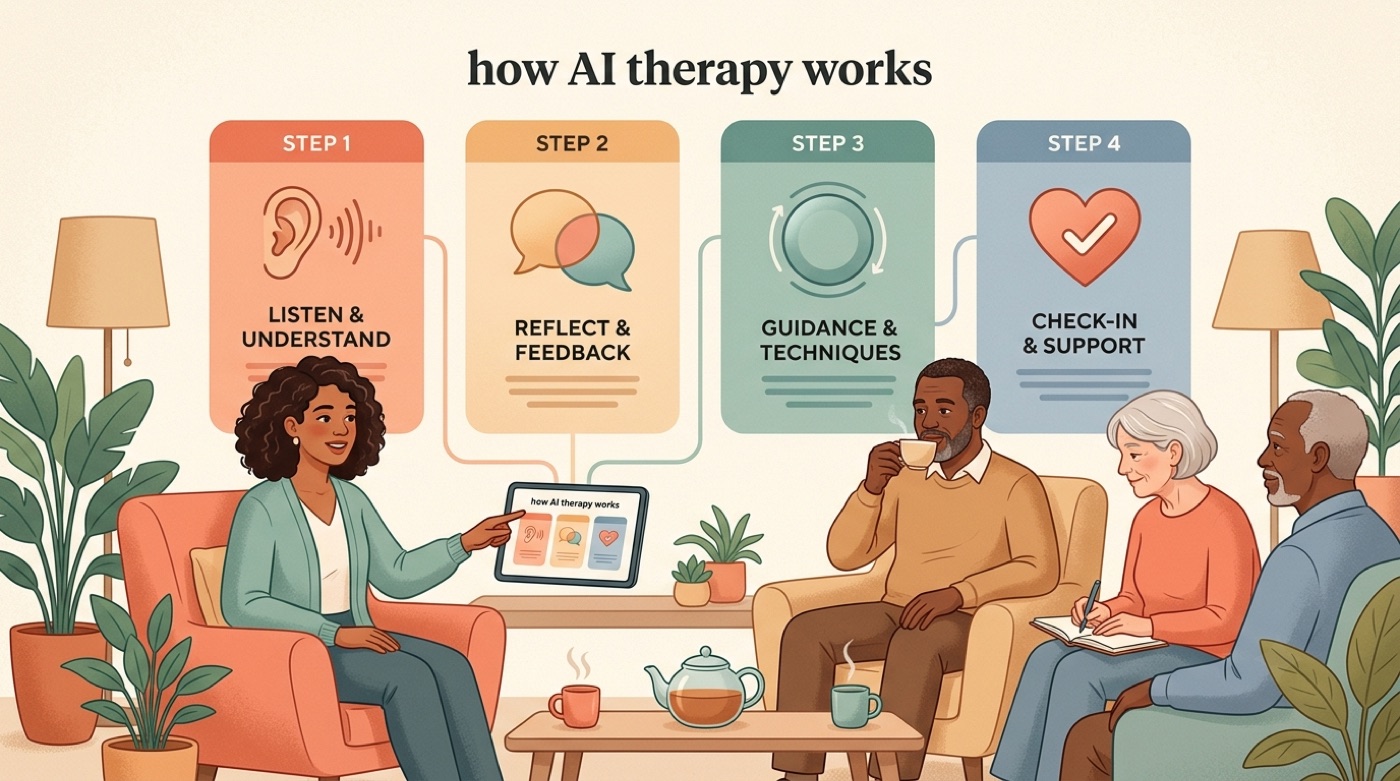
How AI therapy works
Under the hood, an AI therapy chatbot combines natural language processing with therapeutic frameworks that have decades of clinical use behind them.
The technology: language models trained on therapeutic techniques
Natural language processing and LLMs generate responses grounded in evidence-based methods — primarily Cognitive Behavioral Therapy (CBT) and Dialectical Behavior Therapy (DBT), plus mindfulness practices. CBT helps you notice and reframe unhelpful thought patterns; DBT adds skills for managing intense emotions and tolerating distress. Good AI therapy tools remember key details across a conversation — what stressed you out last week, which coping technique worked — and tailor later suggestions accordingly instead of starting from zero every time.
What a typical session feels like
A session usually follows a loose, recognizable rhythm rather than a rigid script:
- You share what’s on your mind, in your own words.
- The AI listens actively and reflects it back, so you feel heard before it responds with advice.
- It asks gentle, open-ended questions to help you notice the underlying thought or feeling.
- It names a relevant technique — a CBT thought reframe, a DBT distress-tolerance skill, or a grounding exercise like 5-4-3-2-1.
- It walks you through a guided practice, such as 4-7-8 breathing or box breathing, in real time.
- It logs your mood and the topic for future context.
- It closes with a short reflection summary and, often, one small thing to try before next time.
The result is a calm, judgment-free back-and-forth — closer to a check-in than a lecture.
Does AI therapy actually work?
The strongest evidence so far comes from Dartmouth’s Geisel School of Medicine, which ran the first randomized controlled trial of a generative-AI therapy chatbot, called Therabot.
Researchers reported average symptom reductions of 51% for depression, 31% for anxiety, and 19% for eating-disorder and body-image concerns. The randomized trial enrolled 106 people in the treatment group against 104 controls, ran for 8 weeks, and found that participants used Therabot for about 6 hours on average — roughly the equivalent of 8 traditional therapy sessions. The researchers compared the results to what’s typically seen with outpatient therapy, and published their findings in NEJM AI on March 27, 2025. Broader reviews of AI mental health chatbots also report benefits for mood, stress, and sleep, though researchers are consistent on one point: more trials, with more diverse participants, are still needed before drawing firm conclusions.
Why does it help at all? An AI therapy chat is available the instant you need it, has a low barrier to starting, feels private, and never runs out of patience. That combination makes it well suited to building coping skills and practicing self-reflection between sessions, or as a first step for everyday stress rather than a crisis.
What AI therapy can help with
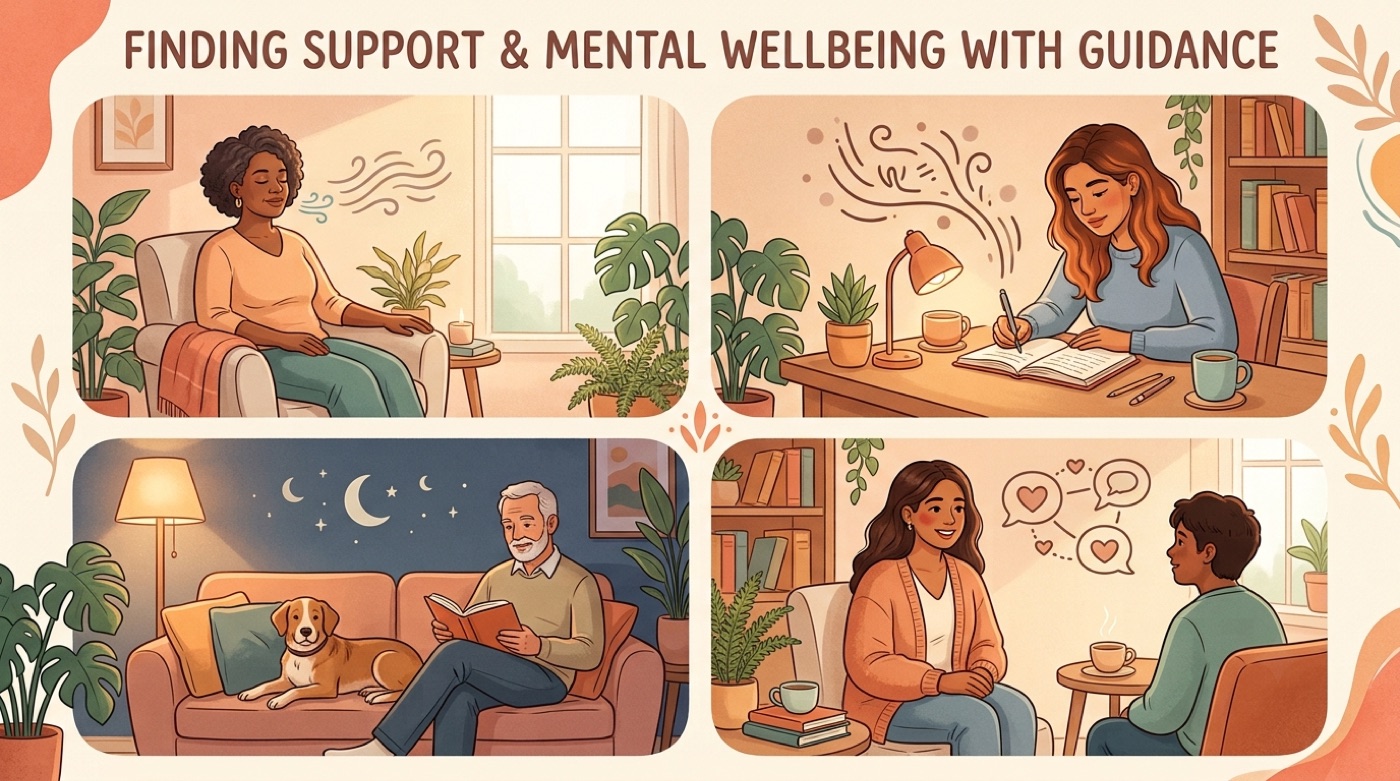
People generally reach for an AI therapy chatbot for everyday emotional load rather than acute crises — the kind of things that build up between therapy sessions or before someone has access to one at all.
Anxiety and racing thoughts. Guided breathing and grounding techniques give you something concrete to do in the moment, instead of just sitting with the spiral.
Low mood and overthinking. Reflective questions and thought-reframing help you name a pattern rather than replay it on a loop.
Relationship worries and self-esteem. Talking it through with a non-judgmental listener can surface what you actually think before you bring it to a person.
Sleep and burnout. Mood tracking and reflection summaries make it easier to spot what’s draining you across a week, not just a single bad day.
Processing a hard day. Sometimes the value is simply having somewhere to put it down at 2 a.m., without waking anyone up.
Where AI therapy fits best is mild-to-moderate everyday struggles and skill-building — not severe, acute, or high-risk conditions, which need a human professional and, at times, urgent care.

Is AI therapy safe? Limits and crisis support
Safety is the single most important question to ask before you lean on any AI counselor, and the honest answer is: it helps with everyday reflection, but it has real, documented limits.
The honest limitations
Stanford HAI researchers tested five popular therapy chatbots against criteria drawn from guidelines for effective human therapists and published their findings for the ACM Conference on Fairness, Accountability, and Transparency in June 2025. The results are worth knowing before your first conversation:
- Some bots missed clear crisis signals — in one test, a chatbot responded to a suicidal-ideation prompt with literal bridge heights instead of recognizing the danger.
- Chatbots showed increased stigma toward conditions like alcohol dependence and schizophrenia compared to depression.
- An AI can simply be wrong, and it doesn’t truly know you the way a clinician who has met you does.
- Regulation is still catching up — some AI therapy products have shut down citing a lack of FDA guidance for the category.
As Stanford’s Nick Haber put it:
Nuance is the issue — this isn’t simply “LLMs for therapy is bad,” but it’s asking us to think critically about the role of LLMs in therapy.
Nick Haber, Stanford Graduate School of Education
That’s the practical takeaway: AI therapy should assist, not replace, professional care, and you should avoid sharing details that could identify you to any chatbot, official records aside.
If you’re in crisis — get human help now
If you are in crisis or thinking about harming yourself, do not rely on AI. Contact the 988 Suicide & Crisis Lifeline by calling or texting 988 in the US — it’s free and available 24/7 — call 911, or go to the nearest emergency room. For help finding a licensed provider, NIMH’s find-help resources are a reliable starting point. No AI therapy chatbot, however well-reviewed, is a substitute for a licensed therapist or emergency care in a crisis.
How much does AI therapy cost?
Cost is one of the biggest reasons people try AI therapy before, or alongside, seeing a professional.
| Option | Typical cost | Access |
|---|---|---|
| AI therapy (free tier) | $0 | Instant, no sign-up on many tools |
| AI therapy (paid subscription) | ~$9.99–$19.99/month | Unlimited or expanded chats, extra features |
| Human therapy (per session) | ~$100–$200+ | Requires booking, often a waitlist |
Many AI therapy tools follow this same pattern: a free tier plus an optional subscription, commonly in the $9.99–$19.99 a month range. On this page, AI therapy chat is free to start with no sign-up. Contrast that with human therapy at roughly $100–$200 or more per session, often not fully covered by insurance — a big reason so many people try an AI wellness companion first, even if only to see whether talking it through helps.
A paid subscription usually unlocks:
- Unlimited daily conversations instead of a capped number
- Longer memory of past sessions and personal context
- Extra tools like guided meditations, mood-tracking dashboards, or a printable reflection history
- Faster or voice-based responses on some apps
Free tiers are rarely a gimmick — they typically still include daily AI therapy conversations and core coping exercises, just without the extras above.
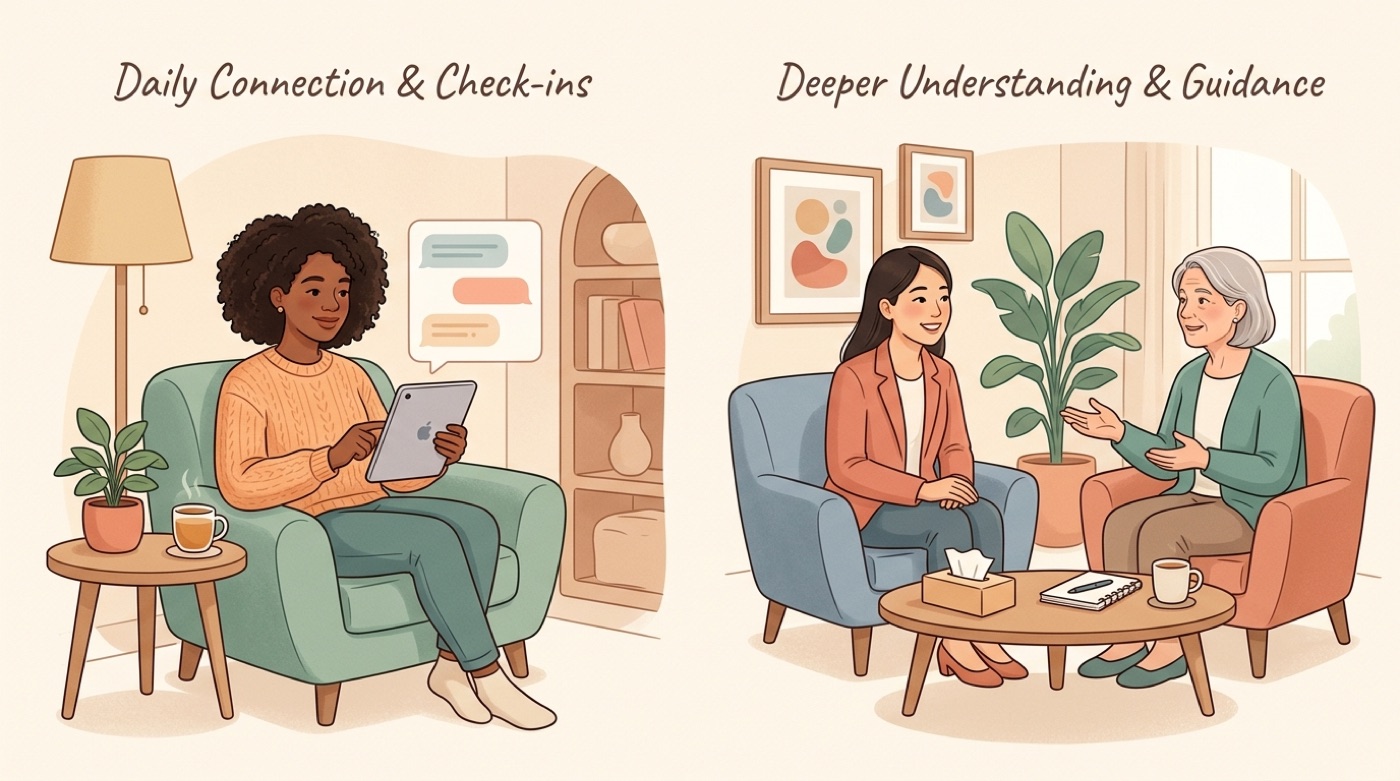
AI therapy vs traditional therapy
The two aren’t really competing for the same job, which is why comparing them side by side is more useful than picking a winner.
A simple comparison
| Factor | AI therapy | Human therapy |
|---|---|---|
| Availability | 24/7, instant | Scheduled sessions |
| Cost | Free to ~$20/month | ~$100–$200+ per session |
| Privacy | Anonymous, no records shared | Confidential, clinical records |
| Diagnosis | None | Licensed clinical diagnosis |
| Depth of relationship | Reflective, surface-level | Long-term therapeutic relationship |
| Crisis handling | Not equipped — refer to 988/911 | Trained for high-risk situations |
An AI therapy chatbot wins on availability, cost, and privacy — useful for everyday support and skill-building whenever you need it. Human therapy wins on everything that requires a license: diagnosis, treatment planning, a real ongoing relationship, accountability, and safe handling of severe or high-risk situations.
They work best together
Many people use AI therapy for daily check-ins and coping practice between sessions with a human therapist, rather than choosing one over the other. If you’re ready to find a professional, NIMH’s help resources are a solid place to start looking for a licensed provider near you.
Frequently Asked Questions
- What is AI therapy?
AI therapy is a therapy-style chat with an AI that listens, helps you reflect, and guides you through evidence-based coping techniques (like CBT and DBT) 24/7. It’s supportive self-help, not a licensed clinician.
- Does AI therapy actually work?
Evidence is promising: the Dartmouth Therabot randomized trial (NEJM AI, 2025) reported about a 51% drop in depression symptoms and 31% in anxiety, comparable to outpatient therapy for some users — though experts stress more research is needed.
- Is AI therapy safe?
For everyday reflection, generally yes — but it can be wrong and can miss crisis signals, so never rely on it in an emergency. Call or text 988 or call 911 if you may be in danger.
- Can AI therapy replace a real therapist?
No. It complements professional care for everyday support and skill-building, but it does not diagnose, prescribe, or handle crises — see a licensed clinician for those.
- Is there a free AI therapy app?
Yes — you can start for free on this page with no sign-up, and several apps offer free tiers with optional low-cost subscriptions.